> ## Documentation Index
> Fetch the complete documentation index at: https://docs.mainwp.com/llms.txt
> Use this file to discover all available pages before exploring further.
# Quickstart
> Connect Claude Desktop to your MainWP Dashboard and run your first prompt.
This page takes you from nothing to a working connection in Claude Desktop. Using a different AI tool? The steps are the same shape; grab your config from [Connect Your AI Client](/mcp-server/clients) after step 2.
## Before you start
You need:
* A MainWP Dashboard on version 6.0 or later, reachable over HTTPS
* Admin access to the WordPress site that runs your Dashboard
* [Node.js](https://nodejs.org) 20.19 or later on the computer where your AI tool runs. Node.js is the free runtime the server runs on; if you don't have it, the standard installer from nodejs.org is all you need.
* [Claude Desktop](https://claude.ai/download), or another AI tool that supports MCP
An Application Password is a separate password WordPress issues for tools like this one. It never changes your login password and you can revoke it at any time.
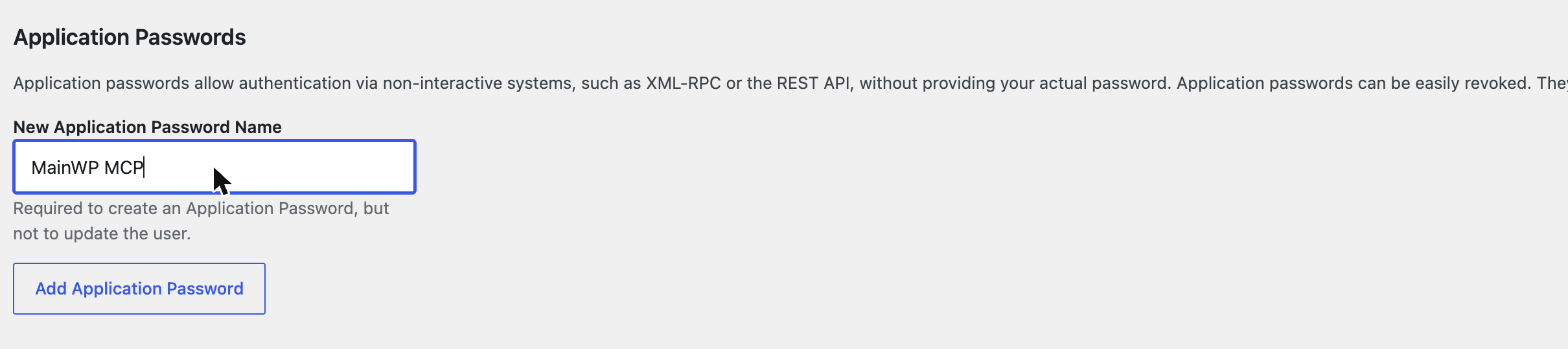
In the WordPress admin of your Dashboard site, go to **Users → Profile** and scroll to the **Application Passwords** section. Enter a name you will recognize later, such as **MainWP MCP**, and click **Add Application Password**.
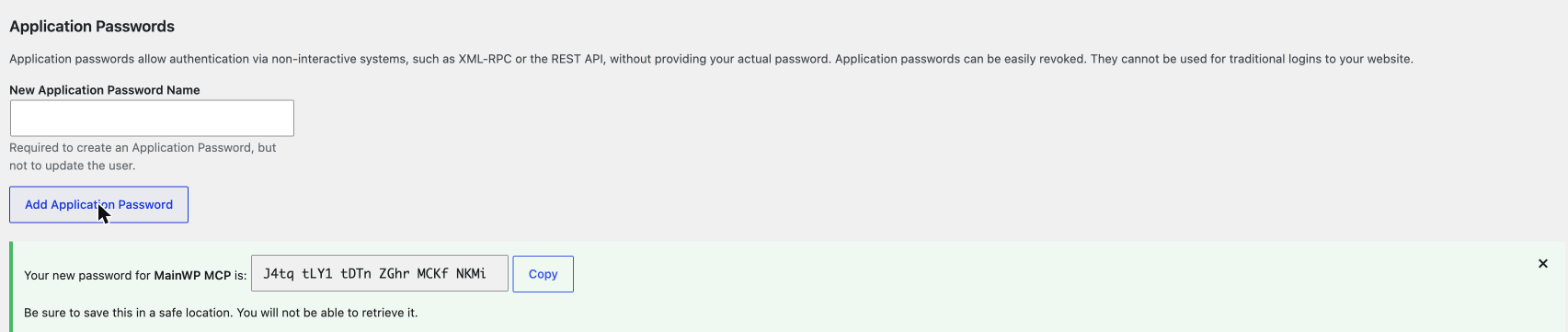
 WordPress shows the generated password once. Copy it now; you cannot view it again later (you can always create a new one).
 Edit the Claude Desktop configuration file:
* **macOS**: `~/Library/Application Support/Claude/claude_desktop_config.json`
* **Windows**: `%APPDATA%\Claude\claude_desktop_config.json`
Add the MainWP server to the `mcpServers` block (create the file if it does not exist):
```json theme={null}
{
"mcpServers": {
"mainwp": {
"command": "npx",
"args": ["-y", "@mainwp/mcp"],
"env": {
"MAINWP_URL": "https://your-dashboard.com",
"MAINWP_USER": "admin",
"MAINWP_APP_PASSWORD": "xxxx xxxx xxxx xxxx xxxx xxxx"
}
}
}
}
```
Replace the URL with your Dashboard address, the username with the WordPress user that owns the Application Password, and the password with the one WordPress generated. Spaces in the password are fine either way, WordPress accepts it with or without them.
Quit and reopen Claude Desktop so it picks up the new configuration. The MainWP tools load automatically when the app starts.
Ask:
> List all my sites
A working setup returns your child sites by name and URL. From there, try "What sites need updates?" or anything from the [Prompt Cookbook](/mcp-server/prompt-cookbook).
Consider creating a dedicated WordPress user for AI access instead of using your main admin account. It keeps the audit trail clean and is easy to revoke later. More on this in the [Security Model](/mcp-server/reference/security).
## If something didn't work
* Nothing happens or the tools are missing: recheck the config file location and JSON syntax, then restart the app again.
* Errors mentioning 401 or authentication: the username must exactly match the user that owns the Application Password.
* Anything else: the [Troubleshooting](/mcp-server/troubleshooting) page covers the common failures with fixes.
## Next steps
Claude Code, Cursor, VS Code Copilot, OpenAI Codex, ZenCoder, and more.
Deletions require your approval by default. See how that works.
Edit the Claude Desktop configuration file:
* **macOS**: `~/Library/Application Support/Claude/claude_desktop_config.json`
* **Windows**: `%APPDATA%\Claude\claude_desktop_config.json`
Add the MainWP server to the `mcpServers` block (create the file if it does not exist):
```json theme={null}
{
"mcpServers": {
"mainwp": {
"command": "npx",
"args": ["-y", "@mainwp/mcp"],
"env": {
"MAINWP_URL": "https://your-dashboard.com",
"MAINWP_USER": "admin",
"MAINWP_APP_PASSWORD": "xxxx xxxx xxxx xxxx xxxx xxxx"
}
}
}
}
```
Replace the URL with your Dashboard address, the username with the WordPress user that owns the Application Password, and the password with the one WordPress generated. Spaces in the password are fine either way, WordPress accepts it with or without them.
Quit and reopen Claude Desktop so it picks up the new configuration. The MainWP tools load automatically when the app starts.
Ask:
> List all my sites
A working setup returns your child sites by name and URL. From there, try "What sites need updates?" or anything from the [Prompt Cookbook](/mcp-server/prompt-cookbook).
Consider creating a dedicated WordPress user for AI access instead of using your main admin account. It keeps the audit trail clean and is easy to revoke later. More on this in the [Security Model](/mcp-server/reference/security).
## If something didn't work
* Nothing happens or the tools are missing: recheck the config file location and JSON syntax, then restart the app again.
* Errors mentioning 401 or authentication: the username must exactly match the user that owns the Application Password.
* Anything else: the [Troubleshooting](/mcp-server/troubleshooting) page covers the common failures with fixes.
## Next steps
Claude Code, Cursor, VS Code Copilot, OpenAI Codex, ZenCoder, and more.
Deletions require your approval by default. See how that works.