> ## Documentation Index
> Fetch the complete documentation index at: https://docs.mainwp.com/llms.txt
> Use this file to discover all available pages before exploring further.
# Maintenance
> MainWP Maintenance helps you remove revisions, comments, empty taxonomies, and transients, then run scheduled cleanup across selected child sites.
## What You'll Learn
* Available cleanup tasks in MainWP Maintenance
* Running maintenance for selected sites, tags, or clients
* Creating and managing recurring maintenance schedules
* Pausing, resuming, and bulk-managing schedules
* Understanding schedule status and target counts
* What remains from the legacy 404 email alerts feature
## Prerequisites
* MainWP Maintenance Extension is installed and activated.
* You have connected MainWP Child sites.
* You have a recent database backup for the sites you plan to maintain.
***
**Extension Add-on** - This add-on provides standalone functionality within MainWP Dashboard. No third-party plugins are required.
[MainWP Maintenance Extension](https://mainwp.com/add-on/maintenance/) lets you clean and optimize child site databases without logging in to each site separately. You can remove revisions, drafts, trash content, comments, empty taxonomies, and transients, then run database optimization from one place in MainWP Dashboard.
Create a database backup before you run maintenance. Database optimization and deleting all transients can temporarily affect performance while cached data is rebuilt.
## Maintenance Options
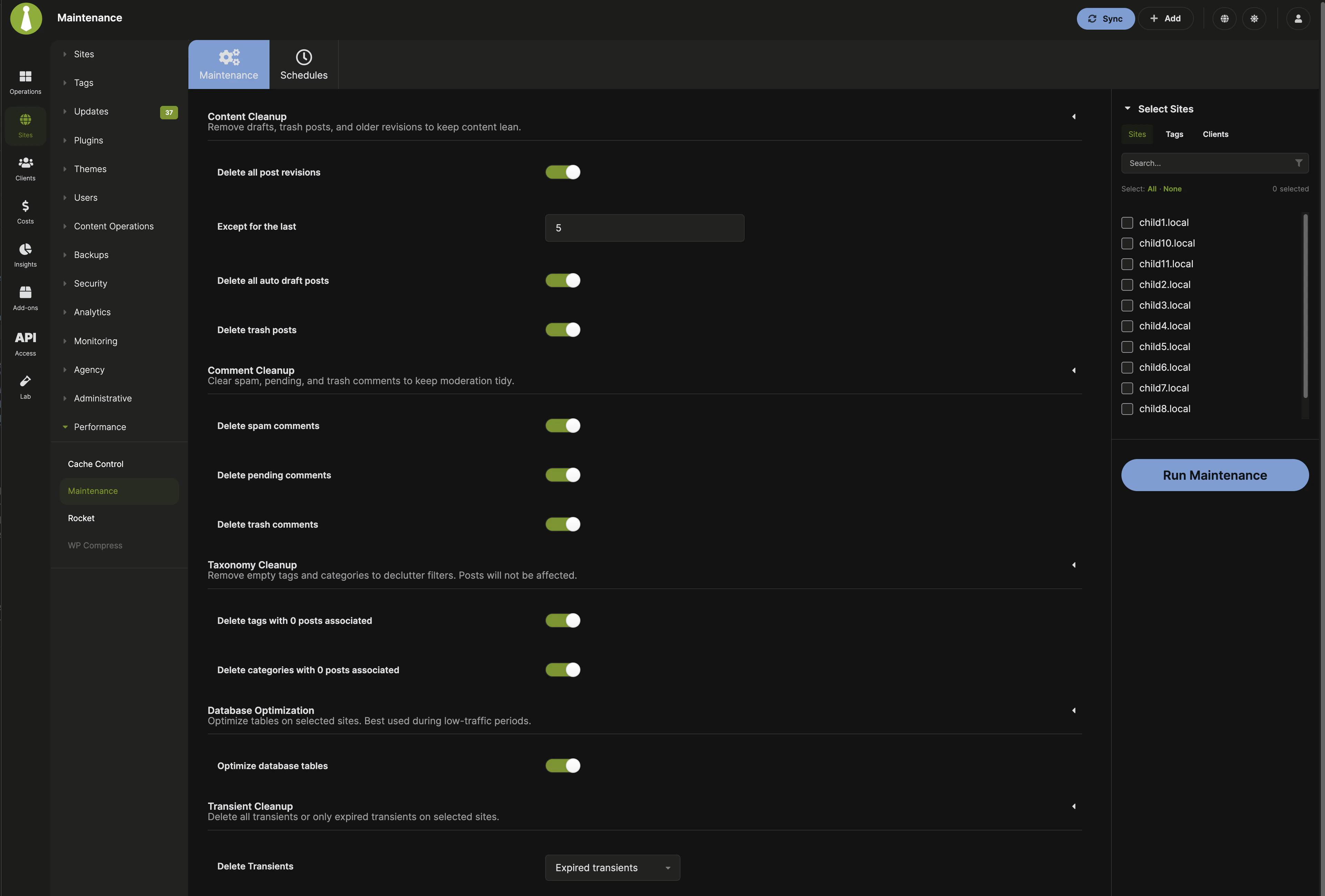
MainWP Maintenance groups cleanup actions into the following sections:
### Content Cleanup
* Delete all post revisions
* Delete all auto draft posts
* Delete trash posts
* Use **Except for the last** to keep the newest revisions. Enter `0` to delete all revisions.
### Comment Cleanup
* Delete spam comments
* Delete pending comments
* Delete trash comments
### Taxonomy Cleanup
* Delete tags with 0 posts associated
* Delete categories with 0 posts associated
### Database Optimization
* Optimize database tables
### Transient Cleanup
* **Don't Delete Transients**
* **Expired transients**
* **All Transients**
Selecting **All Transients** shows an additional warning because some plugins may briefly regenerate cached data after the cleanup completes.
## Run Maintenance
Go to **MainWP > Add-ons > Performance > Maintenance** and stay on the **Maintenance** tab.
Select the maintenance options you want to run. If you enable **Delete all post revisions**, set **Except for the last** to the number of revisions you want to keep.
In **Transient Cleanup**, choose whether you want to skip transients, delete only expired transients, or delete all transients.
Use the **Select Sites** accordion to choose targets by **Sites**, **Tags**, or **Clients**.
Click **Run Maintenance**, then confirm any warnings for database optimization or deleting all transients.
MainWP displays a progress window while the selected tasks run on each child site.
## Schedule Maintenance
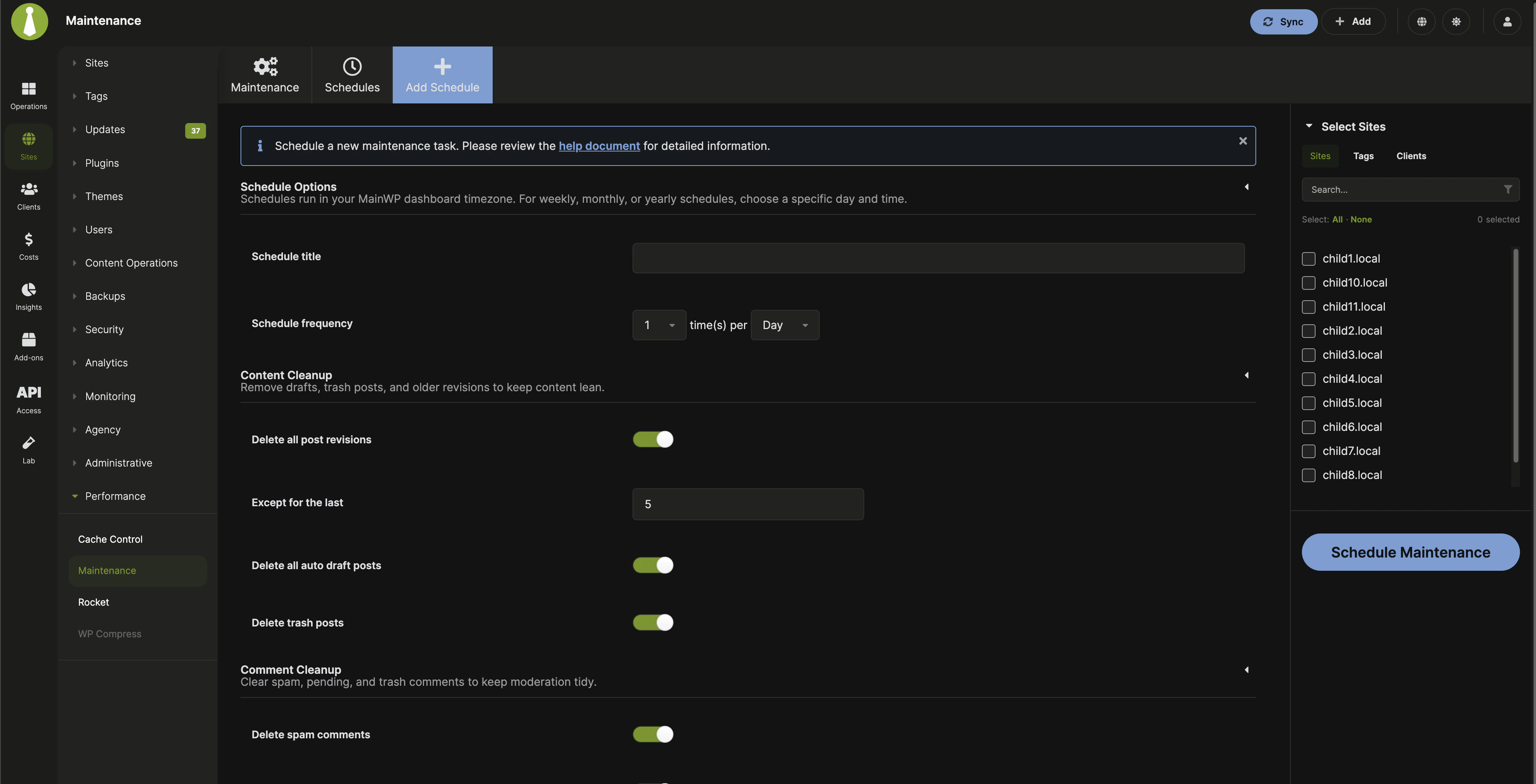
Go to **MainWP > Add-ons > Performance > Maintenance > Schedules**, then click **Create New Schedule**.
Enter a **Schedule title**, then choose the **Schedule frequency**. The saved schedules table displays these frequencies in natural wording, such as **Once per day**, **Twice per day**, or **5 times per month**.
Schedules use your MainWP Dashboard timezone. For weekly, monthly, and yearly schedules that run once per period, choose the run day and hour in **Schedule Options**.
Leave **Paused** disabled if the schedule should run automatically. Enable **Paused** if you want to save the schedule without allowing it to run until you resume it.
Select the cleanup options, revision retention value, and transient cleanup mode you want the schedule to use.
In the **Select Sites** accordion, choose child sites by **Sites**, **Tags**, or **Clients**.
Click **Schedule Maintenance**.
## Manage Scheduled Tasks
The **Schedules** table lists each saved task and gives you a quick view of schedule health, target scope, and run timing.
* **Title** - Shows the schedule title and frequency.
* **Status** - Shows the current schedule state.
* **Target** - Shows a count with an icon for selected Sites, Tags, or Clients.
* **Last Run** - Shows the last scheduled run time.
* **Next Run** - Shows the next planned run time, or `-` for paused or unscheduled tasks.
* **Actions** - Opens the row action menu.
The run columns use relative times, and the exact timestamps appear in the tooltips.
### Schedule Statuses
| Status | Meaning |
| ----------- | ------------------------------------------------------------------------------------------------- |
| Paused | This schedule is disabled and will not run automatically until resumed. |
| Running | Cleanup is currently in progress. |
| Failed | The last cleanup attempt failed. Click the status label to review failure details when available. |
| Unscheduled | No valid next run is currently set. |
| Scheduled | The next run is planned normally. |
| Due | The schedule is waiting for WP-Cron to trigger. |
| Delayed | The scheduled run is overdue. |
| Missed | The task appears to have missed its expected run window. |
When a scheduled run fails on one or more child sites, MainWP stores the failed site details. Click the **Failed** status label to open the failure details modal and review the site name, URL, and recorded error when available.
### Use Row Actions
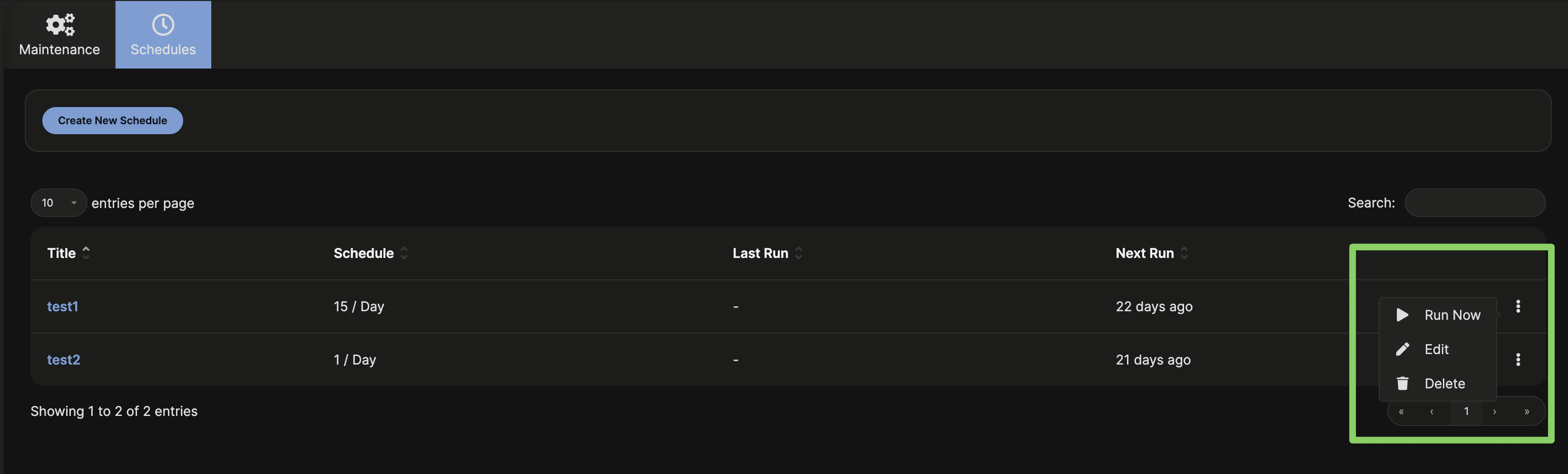
In the **Schedules** table, use the ellipsis menu on the right side of the schedule row.
Choose **Run Now** to execute the saved maintenance task on demand.
Choose **Pause** to temporarily stop the schedule without deleting it. Choose **Resume** to calculate a new next run time and allow the schedule to run automatically again.
Choose **Edit**, update the schedule or maintenance options, and click **Save Changes**.
Choose **Delete** to remove the saved maintenance task.
### Use Bulk Actions
Use bulk actions when you need to update multiple schedules at once.
Check each schedule you want to update, or use the header checkbox to select all visible schedules.
In **Bulk actions**, choose **Pause**, **Resume**, or **Delete**.
Click **Apply**. MainWP processes the selected schedules and shows a success or failure message when the action completes.
## 404 Email Alerts (Legacy)
#### **Feature retired for new users since version 4.1**
The legacy **404 Email Alerts** feature is no longer part of the standard Maintenance workflow for new installations. Current Maintenance documentation focuses on database cleanup and scheduled maintenance tasks.
If you already use an older setup that still exposes 404 alerts, you can continue managing the notification email address and selected sites from that legacy screen.
***
## Related Resources
* [Performance Add-ons](/add-ons/performance) - Browse all performance tools
* [Database Updater](/add-ons/updates/mainwp-database-updater-extension) - Database update management
* [Advanced Uptime Monitor](/add-ons/monitoring/advanced-uptime-monitor-extension) - Monitor site uptime
 ### Schedule Statuses
| Status | Meaning |
| ----------- | ------------------------------------------------------------------------------------------------- |
| Paused | This schedule is disabled and will not run automatically until resumed. |
| Running | Cleanup is currently in progress. |
| Failed | The last cleanup attempt failed. Click the status label to review failure details when available. |
| Unscheduled | No valid next run is currently set. |
| Scheduled | The next run is planned normally. |
| Due | The schedule is waiting for WP-Cron to trigger. |
| Delayed | The scheduled run is overdue. |
| Missed | The task appears to have missed its expected run window. |
When a scheduled run fails on one or more child sites, MainWP stores the failed site details. Click the **Failed** status label to open the failure details modal and review the site name, URL, and recorded error when available.
### Use Row Actions
### Schedule Statuses
| Status | Meaning |
| ----------- | ------------------------------------------------------------------------------------------------- |
| Paused | This schedule is disabled and will not run automatically until resumed. |
| Running | Cleanup is currently in progress. |
| Failed | The last cleanup attempt failed. Click the status label to review failure details when available. |
| Unscheduled | No valid next run is currently set. |
| Scheduled | The next run is planned normally. |
| Due | The schedule is waiting for WP-Cron to trigger. |
| Delayed | The scheduled run is overdue. |
| Missed | The task appears to have missed its expected run window. |
When a scheduled run fails on one or more child sites, MainWP stores the failed site details. Click the **Failed** status label to open the failure details modal and review the site name, URL, and recorded error when available.
### Use Row Actions